The coordination problem
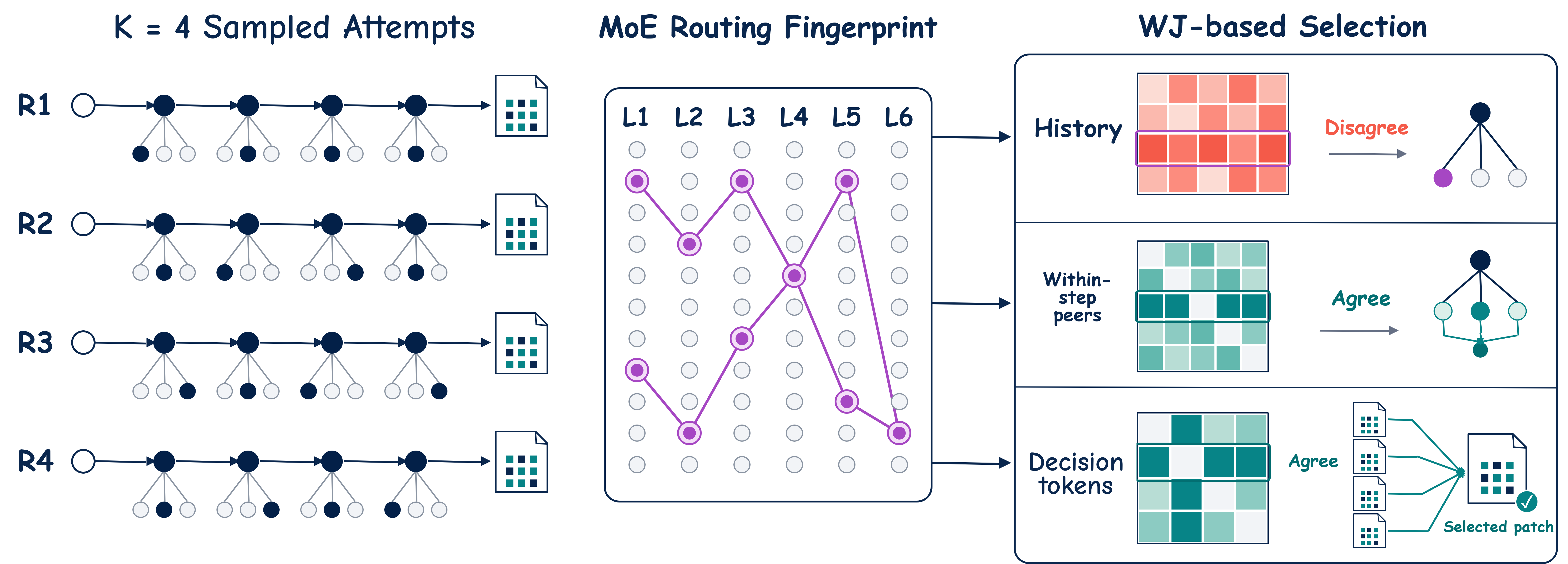
Repository-level repair unfolds through long tool-use trajectories. More test-time compute creates two related but structurally different choices: which action to execute among siblings sampled from the same prefix, and which non-canonical patch to submit after several complete attempts.
Text agreement alone is difficult to interpret across heterogeneous actions and independently developed patches. RISA asks whether the router traces already produced by sparse mixture-of-experts models can provide a shared computational coordinate for both decisions.
The routing fingerprint supplies the coordinate; the comparison set supplies its decision meaning.
One signal, three comparisons
- Fingerprint each action. Gate-weighted expert assignments are aggregated into a layer-by-expert routing fingerprint over the proposed action span.
- Disagree to explore. Outside a write cohort, RISA favors candidates least similar to the attempt’s recent executed history, discouraging computational revisitation.
- Agree to commit. When several candidates propose writes, a routing role gate restricts comparison to that cohort and rewards broad peer-supported convergence.
- Arbitrate across attempts. Each final diff is re-encoded once. Agreement at the least-probable quarter of patch tokens—the decision tokens—selects the routing medoid among the available patches.
The controller requires no external judge, no model-weight updates, and no candidate test execution performed solely for selection.
What the evaluation shows
Across six gpt-oss model-and-effort conditions on SWE-bench Verified, RISA improves over uniform patch selection by 2.3–5.7 percentage points. Its macro-average resolved rate rises from 44.9% to 48.2%, slightly above the 48.0% achieved by text consensus on the same attempt pools.
The same decision rules transfer to Qwen3.6-35B-A3B after refitting only architecture-dependent role centroids. RISA reaches 45.2%, compared with 41.7% for Uniform and 45.0% for text consensus. The routing role gate agrees with the exact parsed action role on 96.8% of actions.
Supporting diagnostics separate the two gains: routing-guided steering improves the availability of submittable patches, while terminal routing agreement contributes independently when all selectors receive the same fixed attempt pool.
Interpretive boundaries
- The current method assumes accessible sparse-MoE routing traces and repeated trajectories, so it is naturally a white-box technique.
- Terminal comparisons condition on tasks with at least two graded patches; they isolate selection quality rather than unconditional end-to-end success.
- Architecture-dependent role centroids are refit for a new MoE family, although the controller logic and comparison rules remain fixed.
- Routing agreement is reference-dependent: similarity to recent history, write peers, and independent attempts has different operational meaning.