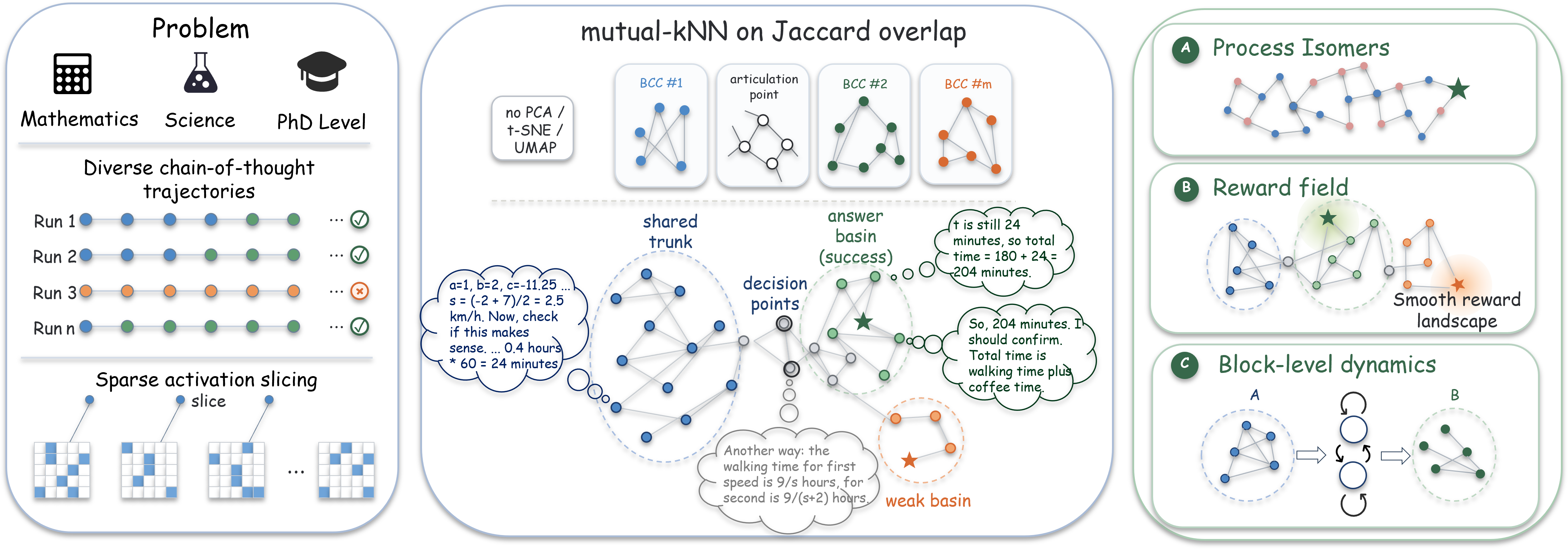
Why final answers are not enough
Multi-run reasoning is commonly summarized with majority vote, pass@k, or another answer-level aggregate. These metrics are useful, but they discard whether trajectories share intermediate computation, split into alternative strategies, or rejoin later.
Two correct runs can be answer-equivalent and still be process-distinct. SliceGraph calls these trajectories process isomers.
A graph of reasoning slices
SliceGraph constructs a separate problem–model-cell graph. Chain-of-thought traces are divided into slices and represented by sparse activation keys. Mutual-kNN edges connect slices with high Jaccard similarity, while biconnected components serve as candidate shared reasoning-state units.
Routes through this atlas are grouped into process families. A label-seeded reward field is analyzed separately, so the graph scaffold describes process geometry without silently baking correctness into its construction. Typed-state transitions then compare how route families navigate the same atlas.
Process isomers are the norm
Across 954 problem–model cells, 85.5% contain correct trajectories with the same normalized answer that split into multiple process families. Among cells with at least two such runs, an average of 76.6% of run pairs cross family boundaries.
Success-associated regions also tend to split into disconnected high-value cores. Route families specialize over different core footprints and exhibit distinct typed-state transition kernels under matched null controls. Representation ablations, cross-architecture replication, and two cross-scale replications support the stability of the route-family scaffold.
Interpretive boundaries
- SliceGraph is a measurement object for post-hoc analysis, not a decoding algorithm or a guarantee of faithful verbalized reasoning.
- Process families depend on slice construction, representation, and graph hyperparameters, even though the reported ablations support robustness.
- Activation similarity indicates representational proximity; it does not by itself prove semantic or causal equivalence.
- Correctness labels enter the value-landscape layer, not the graph scaffold, and should be interpreted as an overlay rather than a structural ground truth.