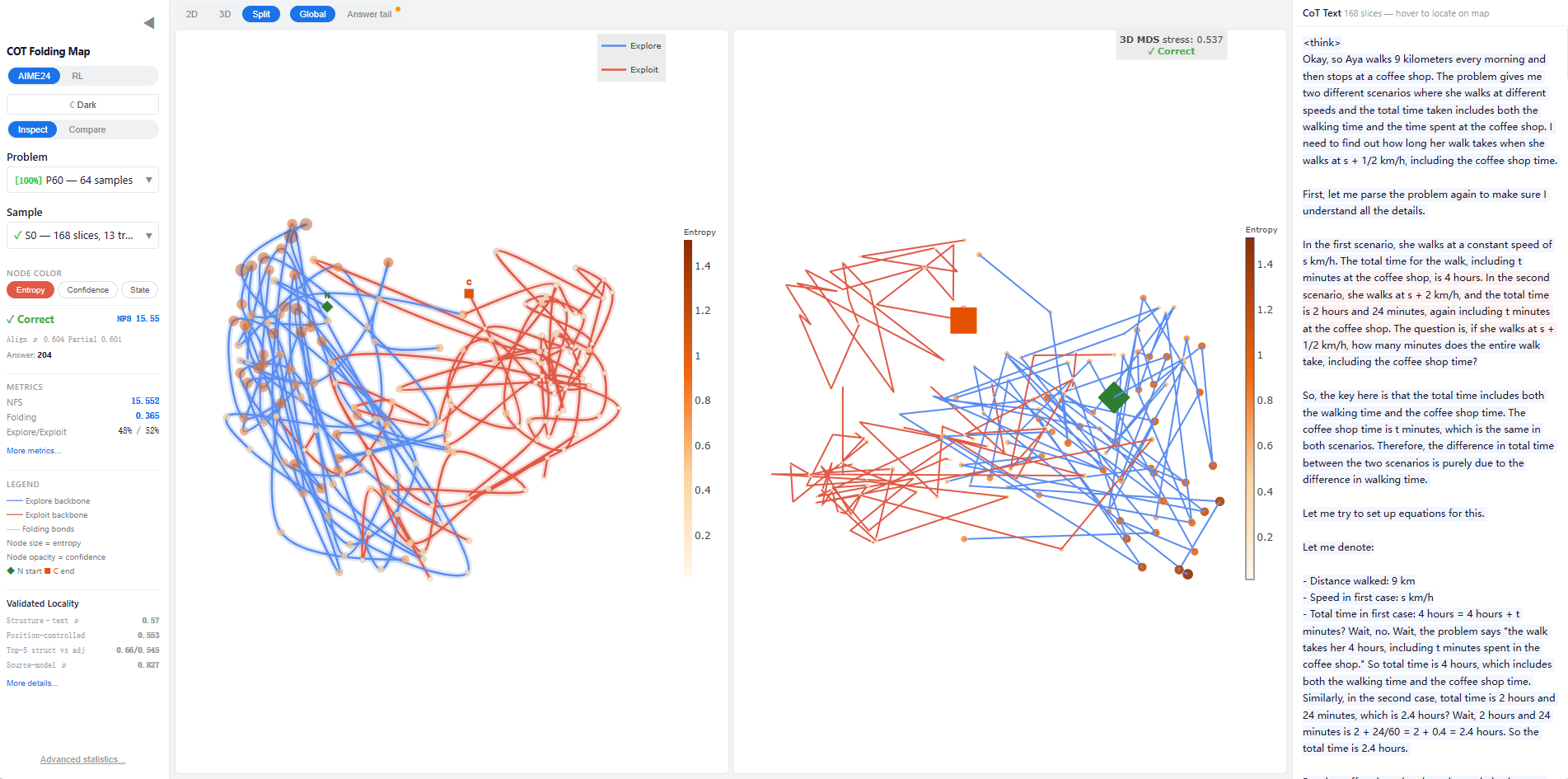
The folding analogy
A chain of thought is divided into 32-token slices. Each slice is represented by a sparse neuron-activation key set, and pairwise Jaccard similarity forms a contact geometry. The analogy to protein folding is operational rather than biological: sequentially distant slices can return to similar internal states, compact regions can form a backbone, and exploratory branches can remain unresolved.
High structural quality combines a dense backbone core, useful long-range return connections, and limited unresolved drift.
Native Fold Score
The parameter-free, unsupervised Native Fold Score (NFS) combines three structural components with a geometric mean:
NFS = 100 × (Backbone × Return × (1 − Adjusted Drift))1/3.
A two-state hidden Markov model separates exploratory and exploitative phases. The analysis extracts a dense exploit core, long-range return edges, drift branches, and final closure; it then repeats the construction at the level of contiguous phase segments.
What NFS measures well
Without correctness labels, slice-level NFS separates correct from incorrect runs with AUROC 0.7646 on AIME 2024 and 0.6857 on GPQA. Aggregating contiguous phases improves AIME discrimination: the segment-average variant reaches 0.8290 AUROC, 0.9295 AUPRC, and 0.8000 Hit@1.
Across 11 reinforcement-learning checkpoints, label-free structural components also track checkpoint accuracy: the strongest reported ranking signal reaches Spearman ρ = 0.8273. Independent semantic comparisons support that the activation geometry contains meaningful information rather than only positional proximity.
What NFS does not guarantee
- Structural coherence is not semantic correctness. A trajectory can be compact and internally consistent around a wrong intermediate result.
- The folding analogy is a visualization and measurement framework, not a mechanistic claim that reasoning literally follows protein physics.
- Reported discrimination is dataset- and model-specific; NFS should be recalibrated and validated before use as a universal quality score.
- The strongest segment-level results are post-hoc analyses and do not establish that optimizing NFS will improve reasoning accuracy.