A harder selection problem
Multilingual evaluation usually compares final-answer accuracy language by language. This project asks a different test-time question: given one trajectory in each of 18 languages for the same problem, can internal activation structure select a stronger answer without seeing correctness labels?
Language identity is not a reliable default: English reaches 16.8% accuracy here, while individual-language accuracy ranges from 11.2% to 22.4%.
Selection through activation agreement
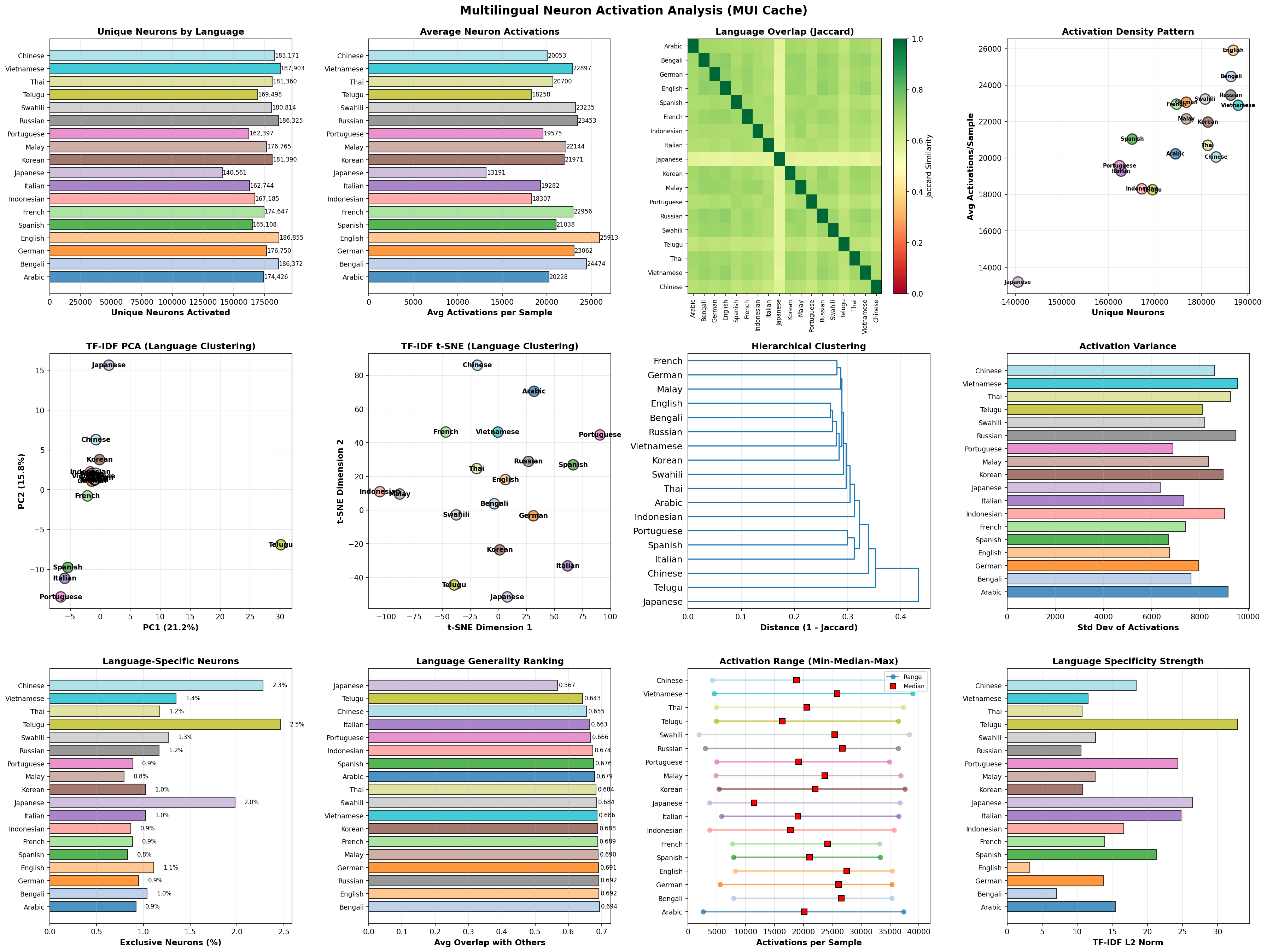
Sparse activated-neuron sets define pairwise Jaccard geometry among the 18 candidate trajectories for each problem. Thirteen selectors test different signals: activation count, medoid centrality, consensus, clustering, language diversity, cross-language consistency, entropy preferences, and language heuristics.
The fixed-first baseline uses Arabic because it is the first candidate in the saved ordering; it solves 26 of 125 problems. The analysis reports selector accuracy at the problem level and separates directly auditable saved results from larger exploratory observations that require unavailable activation caches.
Agreement helps, but modestly
ConsensusMin is the strongest observed selector, solving 32 of 125 problems (25.6%). Medoid centrality and language diversity each reach 24.8%, compared with 20.8% for the fixed-first baseline and 22.4% for the best single language.
Other intuitive heuristics are unreliable. Cross-language consistency reaches 16.0%, low-entropy preference 13.6%, and maximum activation count 12.0%. Auxiliary script-language analysis suggests an association between moderate output-language mixing and accuracy, but the diagnostic is not causal and is limited by script-level language detection.
Evidence tiers and limitations
- The main selector table is backed by compact saved JSON; large activation caches are not redistributed.
- A legacy 99.8% quality-neuron universality claim lacks compact public per-neuron evidence, so it is treated as exploratory rather than a headline result.
- The 125-problem sample is small, and each language contributes only one sampled trajectory per problem.
- Activation agreement offers useful information, but the absolute gain is modest and does not make language identity, fluency, or monolinguality a correctness guarantee.